17th International Logistics Total Expo 2026 (LTT2026) exhibitor series, Part 7
Pallets are not decided by comparing catalogues. What decides them is how they are run. Bought or rented, discarded once or circulated, with or without an assumption that they come back.
Two external conditions are bearing on that premise right now.
The first is standardisation inside Japan. The Pallet Standardisation Subcommittee of the public-private logistics standardisation council set out the specification for a standard pallet in its final report of June 2024: a plan size of 1,100mm × 1,100mm, a height of 144–150mm, a maximum load of 1 tonne, with material and strength per JIS Z 0601.
The second is plant quarantine on export — not somebody else's problem for an importing business. When goods are shipped using wood packaging material to a country that applies quarantine requirements in line with international standard ISPM No. 15, treatment and marking are required under Japan's Implementation Procedures for Disinfection of Wood Packaging Material for Export. Heat treatment means 56°C at the core of the timber for 30 minutes; the alternative is methyl bromide fumigation. Treated material then carries the uniform mark set out in the international standard.
And the important part is what falls outside. The procedures expressly do not cover wood packaging made entirely of thin wood of 6mm or less, or made entirely of processed wood materials such as plywood, particle board, OSB or veneer. A pallet made of plastic or corrugated board is not wood packaging material at all.
The choice of material translates directly into whether a procedure exists on export. Reading the pallet exhibits at LTT2026 as a group, the pitches gathered around exactly this question of how they are run.
Four ways of running them
| Way | What you are deciding |
|---|---|
| ① Buy or rent | Hold them as an asset, or flex the number |
| ② Discard or circulate | End one-way, or build a route back |
| ③ What it is made of | Material sets the paperwork, the hygiene and the life |
| ④ How you build the assumption of return | Who knows how many are where |
① Buy or rent
Rental was prominent. The pitch centres on flexing the number: take more for the peak and give them back in the lull. Owning them means storage and administration in the months you are not using them.
Some exhibitors dealt in used pallets. The reality on show was not a choice between buying and renting but a choice of three: new, used and rented.
What needs checking is how many go out one-way. Rental is a scheme built on their coming back, so using it on a route with no return changes the arithmetic.
② Discard or circulate
This is the way of running them that matters most in import and export.
One exhibit noted that for goods going abroad, single-use one-way is the norm — because there is no route back. Against that, a proposal was on show for circulating rented equipment across borders: collecting at the destination and putting it onto the next consignment.
The pitch rested not only on cost but on reducing waste and packaging material. A one-way pallet becomes waste wherever it lands. Whose burden that is depends on the terms of trade.
What needs checking is the destination, and whether a route back exists. A circulation scheme does not work without a presence in the receiving country.
③ What it is made of
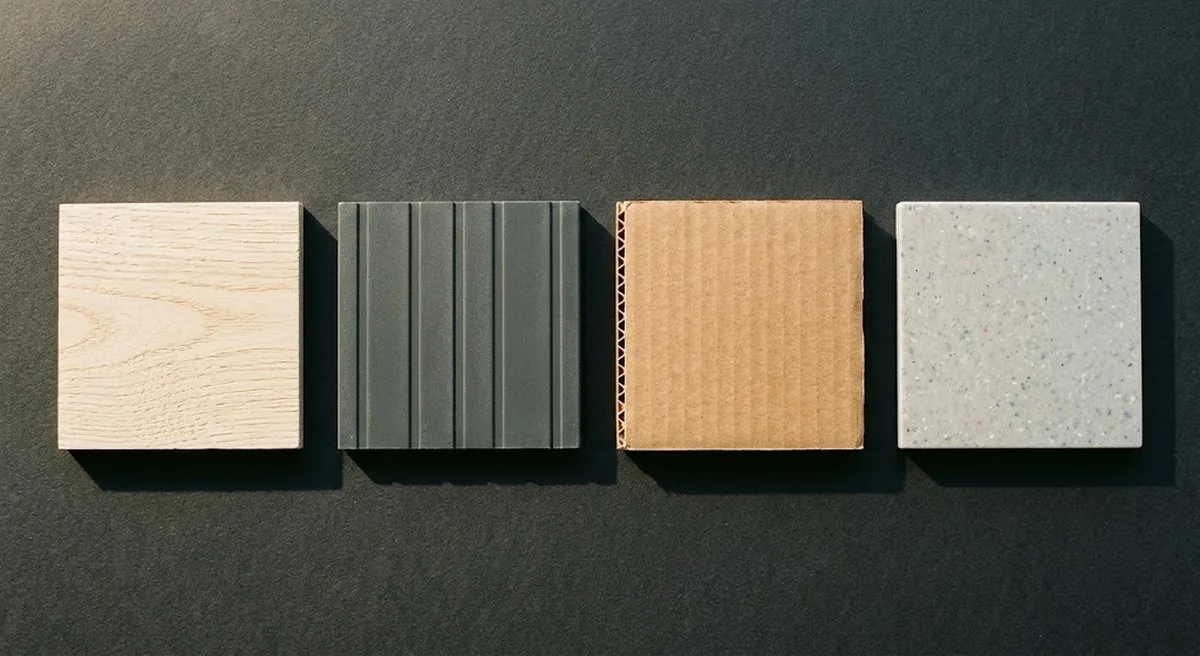
Material looks like a matter of preference, but it settles several operational conditions at once.
Wood — on export it needs the treatment and marking described above. It is cheap and easy to repair, but it rots when wet and it splinters. Among the exhibits were wooden pallets certified as coming from appropriately managed forests — a choice made to answer environmental procurement requirements.
Plastic — not wood packaging material, so it falls outside the treatment and marking requirement on export. It does not rot when wet, and it can be washed. That was the point raised for sites handling food and pharmaceuticals. There were also pallets using recycled feedstock, and pallets made to non-standard sizes from a single unit upward.
Corrugated board — light, and easy to separate for disposal after use. A water-resistant specification was being explored. It suits consignments that go out one-way.
What needs checking is whether it gets wet, whether it gets washed, and whether it gets burned. Those three narrow the material down considerably.
④ How you build the assumption of return
The moment you choose to circulate them, you acquire a new problem: how many are where. Pallets that go out and never come back accumulate as cost, whether rented or owned.
Exhibits showed pallets carrying a means of identifying the individual unit. There were also exhibitors dealing in washing equipment. What comes back is not necessarily ready to use again — a circulating operation has to be designed to include the steps that follow the return.
What needs checking is where they sit idle. Usually that is at the delivery point. If getting them back is work for the receiving side, it is not something you can settle on your own.
Seen from the importer's side
What the four ways had in common was a way of looking at a pallet as a route rather than as a material. Not what one costs, but how many turns one makes. And if it makes none, what it costs on that basis.
In import practice, what bites first is material and destination. If you use wood, check whether the receiving country applies requirements in line with ISPM No. 15, and build the treatment and marking into the schedule. Noticing just before shipment is too late. Choose plastic or corrugated board and the procedure does not arise at all.
Domestically, now that a standard specification has been set out, it is becoming harder to size pallets purely to suit yourself. The option of a non-standard size remains, but it belongs to consignments that stay within your own process. The further a consignment travels outside, the more reasons there are to match the outside standard.
Let us take the enquiries on collectively
Companies that exhibit at a trade show are waiting to be approached. The difficulty is that approaching them one by one means a stream of sales contact, including from firms whose terms do not fit. The more of them there are, the heavier that becomes — and comparing options stops being possible.
We hold an organised record of every exhibit at this show, and we handed our card to each company at the venue. Tell us where they are going, how many a month, and whether they come back, and we will put the question to the firms whose terms fit, then come back to you with the answers consolidated. We will not pass your contact details to any of them without your agreement.
What we provide is information. We hold no distributorship or sales rights for any one company; we set out several ways of running the same consignment side by side. As a company engaged in importing and distributing pharmaceuticals, cosmetics and foods, we will also tell you how wood packaging material is treated for each destination, and how the options fit your storage conditions.
Primary sources consulted
- Ministry of Agriculture, Forestry and Fisheries, Plant Protection Station — Import and export of wood packaging material
- Ministry of Agriculture, Forestry and Fisheries, Plant Protection Station — Implementation Procedures for Disinfection of Wood Packaging Material for Export
- Ministry of Land, Infrastructure, Transport and Tourism — Pallet Standardisation Subcommittee, final report (June 2024)
This article organises trends on the basis of exhibit descriptions published by the organiser and information made public on each company's official website. No individual product or company names are given, and no comparison or evaluation of relative merit is made. The published information is as of August 2026. Quarantine requirements vary by destination country and by consignment; whether they apply in a given case is for the competent authorities to determine.