17th International Logistics Total Expo 2026 (LTT2026) exhibitor series, Part 8
Replacing a forklift is a big decision. Yet reading the LTT2026 exhibits as a group, almost every pitch pointed at keeping the truck you already have. What gets replaced is the battery, the part that grips, and the safety equipment bolted on afterwards.
The move from lead-acid to lithium-ion stood out in particular. And for an importer, that raises three separate lines — which, awkwardly, do not line up with each other.
Three lines, drawn separately
① The Electrical Appliance and Material Safety Act — forklift batteries fall outside it
Lithium-ion storage batteries are regulated under that Act, but they drop out of it depending on use. Those for industrial machinery and equipment are outside its scope, and are handled instead by the Industrial Safety and Health Act. Automotive ones go to the Road Transport Vehicle Act, medical ones to the Pharmaceuticals and Medical Devices Act — the structure routes each use to a different statute.
METI's FAQ poses the question of a battery "used in common between industrial machinery applications outside the Act and machinery applications within it". In other words, the authorities already assume that the same battery can be in or out of scope depending on its use. Looking at a catalogue and concluding "there is no PSE mark, so this must be non-compliant" goes wrong right here.
② Transport — this one applies regardless of use
Even outside that Act, the rules that govern moving the goods remain separate. A lithium-ion battery is dangerous goods under UN3480 once a single cell exceeds 20Wh, or a battery pack exceeds 100Wh, in watt-hour rating. The basis is the Regulations for the Carriage and Storage of Dangerous Goods by Ship, and the public notice setting transport standards for aircraft.
A forklift battery will essentially never fall below those figures. "Outside the Act" and "within the transport rules" hold at the same time, without contradiction.
③ Who counts as the "importing business"
For a battery that is within scope, who carries the notification duty? The FAQ answers: merely acting as an agent for customs and related procedures does not constitute importing. But even an import agent becomes an importing business if it runs a business supplying the imported goods domestically.
Agency or supply. The shape of the commercial flow decides where the duty sits.
Four things to replace
| Replace | What happens to the truck |
|---|---|
| ① The battery | Swapped out. The truck stays |
| ② The charging | The shape of the operating day changes |
| ③ The part that grips | Matched to the load. One truck serves all |
| ④ Add what protects people | Retrofitted on top |
① Replace the battery
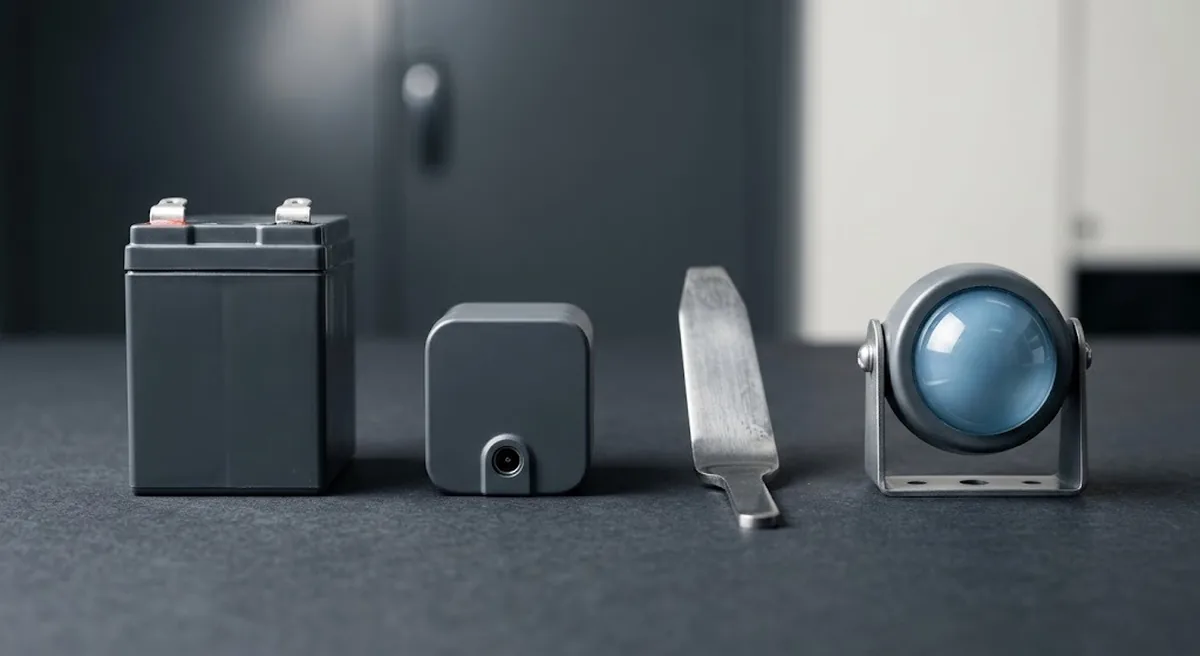
Lead-acid to lithium-ion was the main direction. The phrase that kept recurring was "keep the truck, change only the battery". Some exhibits led with the combination of a used truck and a new lithium pack.
Several placed sodium-ion alongside it — a way of showing that lithium is no longer the only answer.
What needs checking is how many hours, across how many shifts, you run. The gap between lead-acid and lithium bites on whether you can top up mid-shift. On a site that finishes in one shift, the gap narrows.
② Replace the charging
Chargers and power modules were exhibited on their own, and not only for forklifts — units for AGVs and AMRs sat on the same shelf. Powering whatever moves around the site is starting to be treated as one problem.
The other direction was removing the maintenance. Proposals captured under-watering, uneven charging and rapid degradation in lead-acid cells as data, and acted before replacement was due. Extending the battery's life instead of replacing the battery.
What needs checking is where the charging happens. Topping up mid-shift only works if a charger can sit near the break area.
③ Replace the part that grips
Attachments. Powered masts, reach forks, rotating fork positioners, forks with sensors, pallet shuttles, anti-slip surfaces — all of them changing only the business end to suit the load.
This is the move that widens what you can handle without adding trucks. For a load that appears a few times a year, holding one attachment is smaller than holding one more truck.
What needs checking is whether the truck can take it. The hydraulic circuit and the mast specification decide what fits and what does not.
④ Add what protects people
Retrofitted safety equipment. Cameras that detect a person and warn, lasers that show the height of the forks, sensors that flag forks left raised, rear cameras — all built so that the machine catches what gets missed, rather than asking more of the driver's attention.
One exhibit was of a different character: a water-cooled seat for the operator. Heat-illness countermeasures became a legal duty in June 2025, but the duty itself is about a reporting structure and written procedures, not equipment. This sits on the desirable side, not the mandatory side — the subject of Part 5 of this series, reappearing here on top of a vehicle.
What needs checking is whether it can be mounted, and where the power comes from. Retrofits live or die on the mounting point and the cable run.
Seen from the importer's side
What the four had in common was a refusal to add trucks. The replacement decision stays deferred while today's inconvenience gets smaller.
On top of that, importing batteries yourself has an order to it. Use is settled first. Are they going in as industrial machinery batteries, or will they also serve other uses? Until that is settled, whether the Act applies is not settled either. METI's FAQ raises the "used in common" case precisely because sites cannot always draw that line cleanly.
And whichever side the use falls on, the transport rules remain. A battery meeting UN3480 is dangerous goods by sea and by air alike. Noticing just before shipment is too late.
One more thing: the shape of the deal matters. The FAQ states that where ownership does not transfer — rental or lease — the PSE mark is not required (a battery sourced domestically for that purpose must still carry it). Selling or lending. The same object, under different duties.
Let us take the enquiries on collectively
Companies that exhibit at a trade show are waiting to be approached. The difficulty is that approaching them one by one means a stream of sales contact, including from firms whose terms do not fit. The more of them there are, the heavier that becomes — and comparing options stops being possible.
We hold an organised record of every exhibit at this show, and we handed our card to each company at the venue. Tell us how many trucks, how many hours a day, across how many shifts you run them, and we will put the question to the firms whose terms fit, then come back to you with the answers consolidated. We will not pass your contact details to any of them without your agreement.
What we provide is information. We hold no distributorship or sales rights for any one company; we set out several ways of replacing, side by side, for the same site. As a company engaged in importing and distributing pharmaceuticals, cosmetics and foods, we will also tell you where the line between use classification and transport treatment falls.
Primary sources consulted
- Ministry of Economy, Trade and Industry — FAQ on lithium-ion storage batteries (Electrical Appliance and Material Safety Act)
- Japan External Trade Organization (JETRO) — Import procedures for batteries: Japan
- Ministry of Land, Infrastructure, Transport and Tourism — Public notice on standards for the carriage of dangerous goods by ship
This article organises trends on the basis of exhibit descriptions published by the organiser and information made public on each company's official website. No individual product or company names are given, and no comparison or evaluation of relative merit is made. The published information is as of August 2026. Which statute applies varies with the battery's specification, its use and the commercial flow; whether it applies in a given case is for the competent authorities to determine.