Logis-Tech Tokyo 2026 (LTT2026) exhibitor series, Part 4
You want to make moving things around the site easier. At that point the road forks: make the machine bigger, or make what people push lighter.
The first road leads to forklifts, and from there it becomes a question of qualifications. Under Japan's Industrial Safety and Health Act, operating a forklift with a maximum load of under one tonne requires special education, and one tonne or more requires completion of a skills training course. Before you can assign someone, you have to arrange the training.
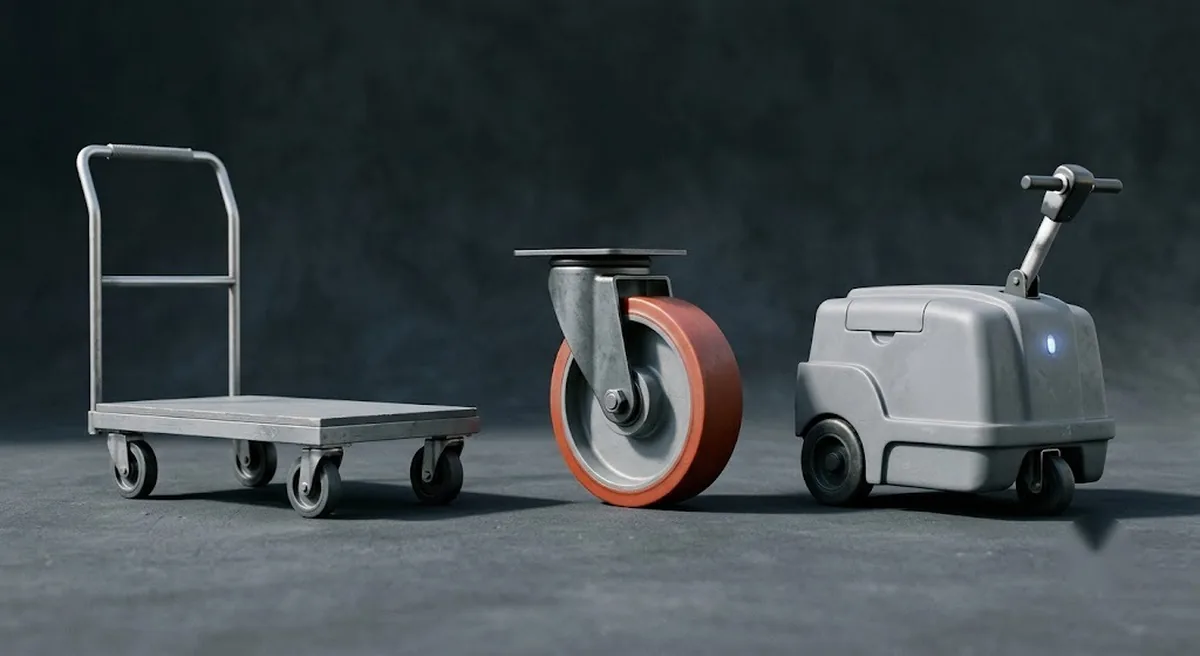
Reading through the trolley, caster, hand-lift and tow-unit exhibits at LTT2026, the pitch gathered on the other road: lowering the burden on the floor without crossing the qualification line.
Four ways to lower it
| Way | What it changes |
|---|---|
| ① Retrofit powered assistance | Keeps the trolleys you already have |
| ② Switch to towing | Turns pushing into pulling |
| ③ Change only the wheels | Lowers the force needed itself |
| ④ Put a dedicated machine on steps | Carves out only the hardest stretch |
① Retrofit powered assistance
A drive unit is fitted to an existing trolley to supplement the pushing force. The pitch centred on not having to replace anything. Replacing the trolleys themselves moves inspection and storage with them; a retrofit leaves the floor routine untouched.
What needs checking is load and gradient. Something that works on the flat behaves differently on a ramp or over a threshold. Only once how many kilos, on what gradient, over what distance are all in hand can suitability be judged.
② Switch to towing
Several trolleys are linked and moved at once. Pushing becomes pulling and the number of round trips falls. The longer the route on site, the more it tells.
This is where the regulatory line divides by machine type. If it does not fall under forklifts it is not subject to the skills training course, but where it is treated as an in-yard transport vehicle, the Industrial Safety and Health Regulations require a work plan to be drawn up. And if it travels on public roads outside the premises, a driving licence becomes a separate matter. The question is not "is a qualification needed?" but "which category does this machine fall into?"
③ Change only the wheels
Neither the trolley nor the route changes; only the casters are swapped. A material with lower rolling resistance, a larger diameter, better swivel — each lowers the force the operator has to apply.
Of the four this is the cheapest and the quickest to try. The choice turns on floor material and whether there are thresholds, so it cannot be settled without looking at the site. Put the other way round: look at the site and it settles.
④ Put a dedicated machine on steps
Rather than the flat, this carves out only the hardest stretch: stair climbers, threshold-crossing mechanisms, structures that let goods be loaded without lifting.
The investment is smaller than mechanising the whole route, and it starts where accidents are likeliest. It rests on a premise: the burden is not spread evenly along the route but concentrated in a particular few metres.
Seen from the importer's side
What the four share is a design idea: make it work without crossing the qualification line. No change of personnel, no waiting on training arrangements, and you can start on today's floor.
But where the line sits varies by machine. Once power is added, which category it falls into, and whether it becomes subject to a work plan, needs checking. Even where something is described as needing no qualification, confirm what exactly it needs none of before adopting it — that step cannot be skipped.
And in import work there is one more thing. Once the load form is fixed, the equipment you need is fixed. Does it arrive by pallet or loose, and what does a carton weigh? Choosing the handling equipment first can leave you with something that does not match the load as it actually arrives.
Let us handle the enquiries for you
Companies that exhibit are waiting to be contacted. The difficulty is that if you approach them one by one yourself, the sales calls keep coming — including from those whose conditions do not fit you at all. The more names on the list, the heavier that becomes, and comparing them properly stops being possible.
We have organised the full set of exhibits from this show, and we handed our card to the exhibitors at the venue. Tell us how many kilos, over what kind of floor, for what distance, and who will be moving it, and we will put the question to the ones that fit and come back to you with the answers together. We will not pass your contact details to anyone without your agreement.
As a company that handles the import and distribution of pharmaceuticals, cosmetics and food, we will also set out how this meshes with your load form and what to verify before adopting anything.
Primary sources consulted
- Ministry of Health, Labour and Welfare, workplace safety site — Work supervisors for cargo handling operations
This article organises trends on the basis of exhibit information published by the organiser and information made public on exhibitors' own websites. No individual product or company names are given, and no comparison or evaluation of merit is made. Published content is as of August 2026. Whether qualifications or training are required, and which category applies, depends on the specification of the machine; whether it applies in an individual case is for the competent authority to judge.
![Three Approaches Seen in the Cold Chain Exhibits — Cool It, Hold It, Record It [Part 2]](/wp-content/uploads/2026/09/incape-ltt-coldchain.webp)
![Logis-Tech Tokyo 2026 — Reading 490 Exhibits Through Nine Categories [Part 1: Overview]](/wp-content/uploads/2026/09/incape-ltt-overview.webp)