17th International Logistics Total Expo 2026 (LTT2026) exhibitor series, Part 6
You want to make packing work easier. Where to start looks like a matter of preference. Japan's official guideline, however, sets an order.
The Ministry of Health, Labour and Welfare's Guideline on Preventing Lower Back Pain in the Workplace says this about handling heavy objects:
As a principle, automate the work using suitable powered equipment; where that is difficult, reduce the physical load by means such as trolleys and assistive devices
Assistive devices do not come first. Automation comes first, and assistive devices come in when automation is difficult. On many sites that order has been reversed.
The guideline also gives figures for the work that remains manual. For male workers aged 18 and over, the weight handled by human force alone should be kept to roughly 40% of body weight or less; for female workers aged 18 and over, to about 60% of that. Those are duties of effort — but for women there is a separate prohibition under the Regulations on Labour Standards for Women: handling objects of 30kg or more in intermittent work, or 20kg or more in continuous work, must not be assigned.
Reading the packaging-machinery exhibits at LTT2026 as a group, they divided cleanly into four, according to where on this ladder of automation each pitch was placed.
Four rungs
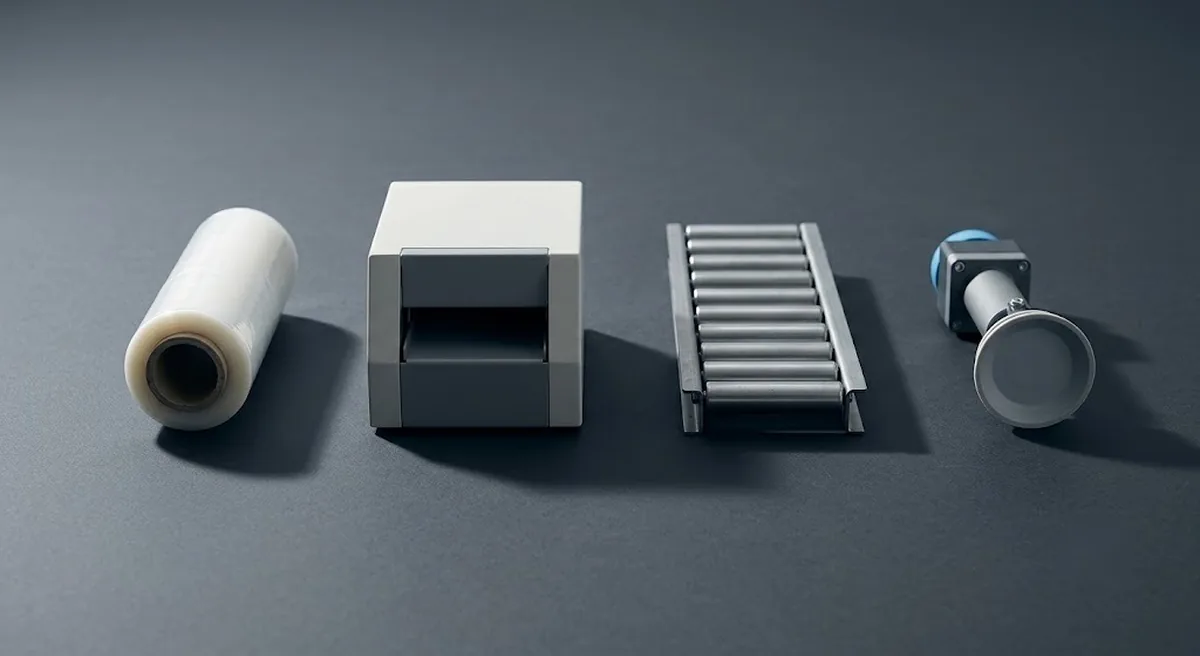
| Rung | What the person still does |
|---|---|
| ① Make it lighter with a tool | Everything. The tool only helps the posture |
| ② Semi-automate on a benchtop | Feed it in. Sealing and wrapping are the machine's |
| ③ Put it on a line | Keep it flowing. Wrapping, sealing and labelling are the machine's |
| ④ Hand it to a robot | Set it up. Stacking is the machine's |
The higher you go, the less a person does — but the more you need to know before deciding. Rung by rung:
① Make it lighter with a tool
No machine; make the work itself easier. Holders for stretch film wrapped by hand, turntables for rotating a pallet — all of them tools for taking the bending and twisting out of the job.
The pitch centres on needing neither installation work nor a power supply. Put it down and it works that day. In the guideline's terms, this is the "load reduction" that applies where automation is difficult.
What is easy to miss is that this is not the bottom rung. On a site that wraps only a few loads a day, stopping here can be the right answer. Climbing the ladder is not the goal in itself.
② Semi-automate on a benchtop
A machine sits on the workbench and the person only feeds it. Bagging, closing the neck of a bag, wrapping small items — all of these led with high-mix, low-volume work.
What this rung buys you is mechanisation without building a line. The layout does not change; the machine goes on the bench you already have. Some combined counting and weighing, so that counting, weighing and wrapping sit in one movement path.
What needs checking is the breadth of your item range. A pitch built on high-mix, low-volume means, turned around, that changeovers will happen. How many items, switched how often? If that is not settled, the machine stops on the floor.
③ Put it on a line
The machine runs continuously from infeed to seal. Side-loading baggers, bagging that varies the length to suit the item, carton erecting and sealing, stretch wrapping — this was the thickest band of exhibits.
What stood out in the pitch was peak season. The capacity is not needed all year; it falls short only when despatch volumes spike. Against that, some offered renting for a defined period — treating it as an expense rather than a capital investment.
The other theme was saving packaging material. Making the bag to the length of the item, wrapping to the contour of the goods — the case for a machine was not built on labour cost alone. Less material also moves the shipping cost.
What needs checking is your daily throughput and the seconds allowed per unit. A catalogue figure is a ceiling, not a site average.
④ Hand it to a robot
Moving the work of stacking boxes onto a pallet across to a machine. This was the rung that meets the guideline most directly: a person stacking 20–30kg sacks all day runs straight into the weight figures above.
What has changed on this rung is the treatment of safety fencing. Configurations that can work in the same space as people were on show, which removes the floor area the fence would have taken. That is why saving space, not only saving labour, appeared in the pitch.
What needs checking is what you are stacking. Cartons and large sacks are gripped differently. Stacking patterns, splitting by delivery destination, stability with heavy items — none of it is decided until the items are.
One line cutting across the rungs — changing the material
Separately from the four rungs, one theme appeared at every level: changing what you wrap with.
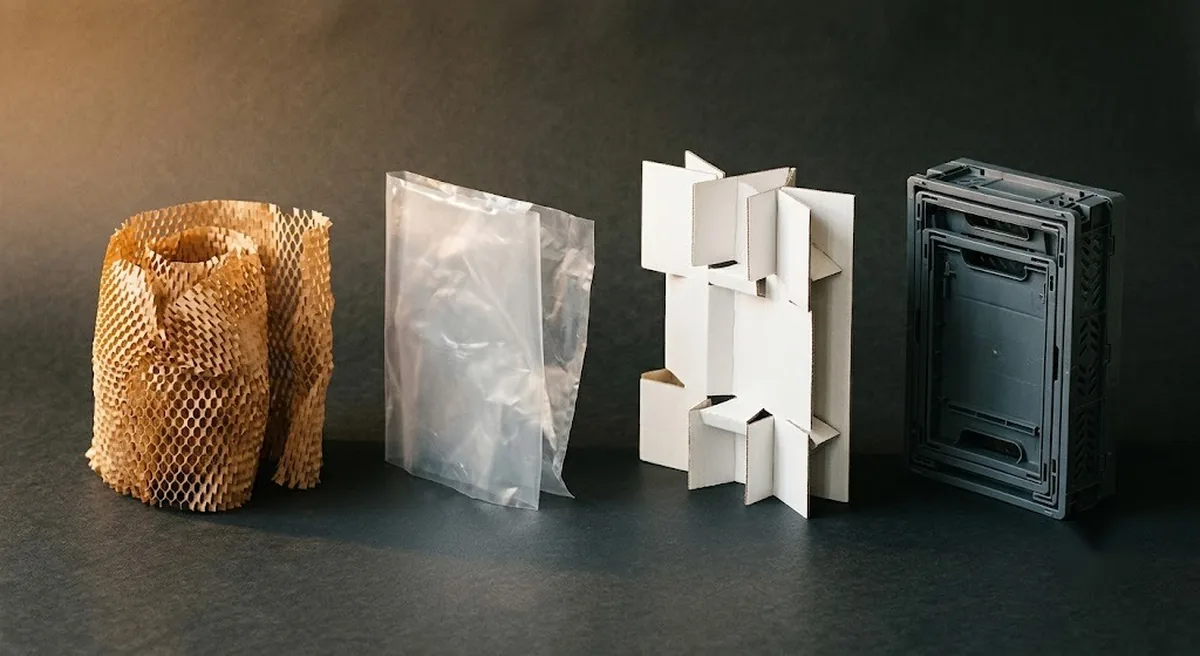
Machines that make paper cushioning on the spot, machines that run on recovered paper, proposals to swap plastic strapping for paper strapping, adhesive used instead of film to stop loads shifting — the machine story and the material story shared the same exhibits.
The reason is simple: change the material and the machine changes. Paper does not run through the same machine as film. A material switch has to be decided at more or less the same time as the machine. Fix either one first and your options on the other narrow.
Seen from the importer's side
What the four rungs had in common was a refusal to mechanise everything at once. Start on the bench, rent for the peak, hand over only the stacking — each keeps the entry small.
In import practice, sequence decides. Until the items are settled, the rung is not. What are you packing, how many a day, how many seconds per unit, and how many people are doing it now? With those four in hand, the right rung narrows down quickly. Choose a machine without them and you end up with capacity that is either idle or short.
And back to the guideline: the weight figures, and the prohibition under the Regulations on Labour Standards for Women, apply whether or not you install a machine. Alongside looking at equipment, find out what your people are actually lifting today. That part settles before the equipment question does.
Let us take the enquiries on collectively
Companies that exhibit at a trade show are waiting to be approached. The difficulty is that approaching them one by one means a stream of sales contact, including from firms whose terms do not fit. The more of them there are, the heavier that becomes — and comparing options stops being possible.
We hold an organised record of every exhibit at this show, and we handed our card to each company at the venue. Tell us what you are packing, how many a day, how many seconds per unit, and how many people are doing it now, and we will put the question to the firms whose terms fit, then come back to you with the answers consolidated. We will not pass your contact details to any of them without your agreement.
What we provide is information. We hold no distributorship or sales rights for any one company; we set out several rungs side by side for the same process. As a company engaged in importing and distributing pharmaceuticals, cosmetics and foods, we will also tell you how labelling and inspection shift when the packaging material changes.
Primary sources consulted
- Ministry of Health, Labour and Welfare — Guideline on Preventing Lower Back Pain in the Workplace (annex to Circular Kihatsu 0618 No. 1)
- Ministry of Health, Labour and Welfare — Promoting the prevention of lower back pain in the workplace (guideline materials)
This article organises trends on the basis of exhibit descriptions published by the organiser and information made public on each company's official website. No individual product or company names are given, and no comparison or evaluation of relative merit is made. The published information is as of August 2026. The scope of the guideline and the regulations, and the measures required, vary with the actual work; whether they apply in a given case is for the competent authorities to determine.