Logis-Tech Tokyo 2026 (LTT2026) exhibitor series, Part 3
More and more businesses want to change their packaging. What stalls the work, though, is not the will to change it but what to change it to.
Behind this sits the law. Under the Act on Promotion of Resource Circulation for Plastics, in force since April 2022, a business whose discharge of plastic-containing industrial waste exceeded 250 tonnes in the previous year is treated as a large-volume discharger and is required to set targets for reducing discharge and for recycling, and to work towards them in a planned way. Such businesses are expected to make efforts to publish how far those targets have been met.
That said, for anyone importing and distributing goods, what actually bites is less whether your own figure reaches 250 tonnes than the moment a trading partner asks whether the packaging could be changed. The pressure comes down from upstream.
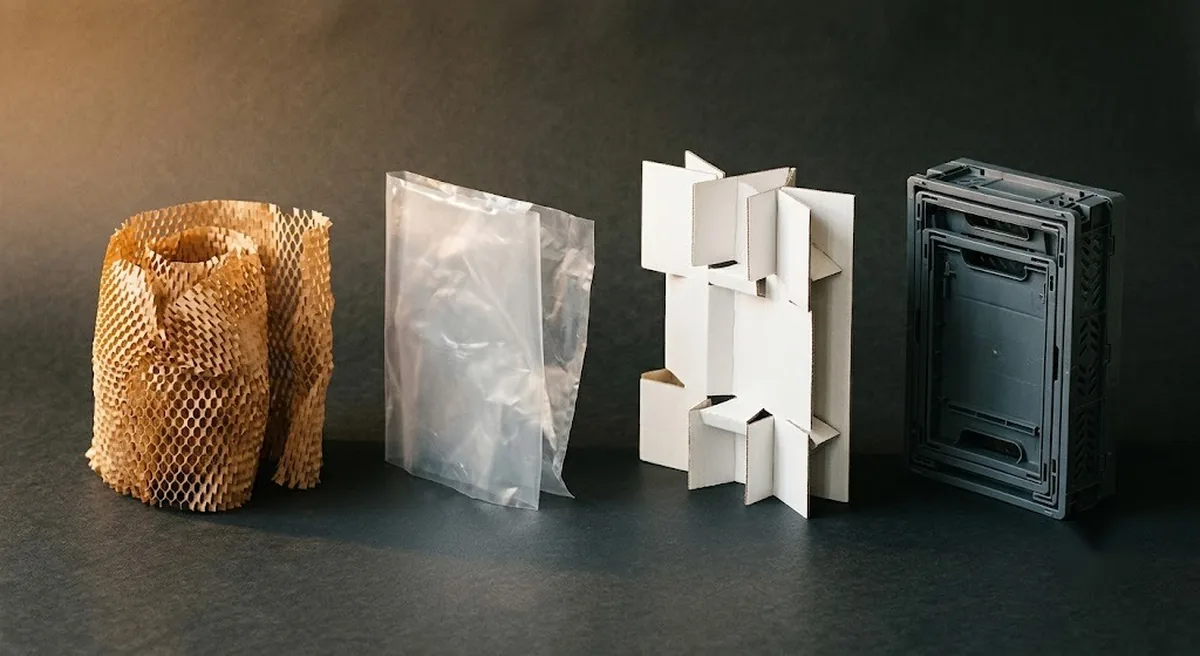
Reading through the packaging and cushioning exhibits at LTT2026, the moves divided clearly into four. What each one changes is different.
Four moves
| Move | What it changes |
|---|---|
| ① Switch to paper and pulp | The material itself |
| ② Use less resin | Keeps the material, reduces the quantity |
| ③ Absorb it with form | Keeps material and quantity, protects by structure |
| ④ Collect and reuse | The assumption that it is disposable |
These four are not parallel options. The reach of the change differs. With ① your supplier and your incoming-inspection criteria both change. By ④, the way your logistics is arranged changes altogether. We will take them in order.
① Switch to paper and pulp — the clearest move, and the one needing most checking
Exhibits taking this move ranged across cushioning, envelopes, trays and moulded pieces, but the pitch pointed the same way: it can go out as waste paper as it is. The explanation that the sorting step disappears was common to them.
Equally common are the points that always come back as questions once you substitute: strength, water resistance and weight. Weight is the one most easily overlooked. Paper tends to add bulk and mass, so the freight can rise by as much as the resin you removed. In importing there are situations where freight is set by volumetric weight, and judging on material cost alone can leave you worse off overall.
Water resistance is decisive for some goods. Where there is condensation in chilled or frozen conditions, or rising humidity on a sea leg, being paper is itself the constraint. The question is not "can we switch to paper?" but "will paper hold for this product under these transport conditions?"
② Use less resin — reducing without replacing
Here the material stays and the quantity comes down: thinner walls, a higher proportion of recycled resin, or simply a smaller pack. The approaches differ but the aim is the same, and the great advantage of this move is that your existing filling and sealing machines carry on working.
What you trade against is the damage rate. Thinner walls lower the material cost, but if breakage in transit rises, returns, re-sends and write-offs make it dearer than before. A reduction percentage on its own settles nothing. The question is not "how much thinner?" but "what happened to the damage rate when we made it thinner?"
As for recycled resin, how far it can be used depends on the product. For food, cosmetics and pharmaceuticals there are separate requirements on containers and packaging, and those bind first.
③ Absorb it with form — choosing not to change the material
Material and quantity both stay, and the structure takes the impact: fixing goods with folds and dividers, letting load escape through how space is left, separating the roles of outer and inner packaging. All of it is design-side work, with no substitution of the material itself.
The advantage of this move is that you do not have to change supplier. Existing relationships and inspection criteria stay as they are; only the design moves. The constraint is just as clear: it has to be designed again for each product, so with many lines in small volumes the effort accumulates.
In import work this is sometimes the fastest to take effect, because switching material brings procurement, inspection and labelling checks with it, whereas changing how you pack is something you can try on your own judgement.
④ Collect and reuse — removing the assumption itself
This move drops the assumption of disposability and collects the packaging to use it again: containers that fold flat for the return leg, structures that can be repaired and kept in service, designs premised on rental or pool operation.
On unit cost alone it looks expensive. The judgement changes once you work it out per use: how many times it can be used, and what collection costs, decide the whole picture.
And this move alone changes how the logistics itself is arranged. You need a return route, cleaning and inspection steps, and a decided way of handling what does not come back. It rarely works for a one-way import; it only becomes an option where there is repeat business with the same counterpart.
Seen from the importer's side
Set side by side, the four show that a decision about packaging does not stay a decision about packaging. Three things move with it.
- The damage rate — the thinner and lighter you go the more easily it rises, and once it rises the saving is cancelled out
- Volume and weight — these feed straight into freight. A lower material cost means nothing if the freight goes up
- Labelling — for cosmetics, food and pharmaceuticals, changing the container or packaging can send the labelling check back to the start
The third is particular to importing. A change of packaging material can move the assumptions behind label area, material indication and identification marking. Finding out that the labelling will not pass after the material has been settled makes the rework much wider. Material selection and the labelling check belong on the same timeline.
And one more thing. The four are not alternatives. Paper on the outer, form on the inner, and collected containers with the partners you deal with repeatedly — the move can differ leg by leg for one and the same product. What has to be settled first is not the material but what is being carried, under which conditions, and to where.
Let us handle the enquiries for you
Companies that exhibit are waiting to be contacted. The difficulty is that if you approach them one by one yourself, the sales calls keep coming — including from those whose conditions do not fit you at all. The more names on the list, the heavier that becomes, and comparing them properly stops being possible.
We have organised the full set of exhibits from this show, and we handed our card to the exhibitors at the venue. Tell us what you are carrying, at what weight, volume and quantity, and to where, and we will put the question to the ones that fit and come back to you with the answers together. We will not pass your contact details to anyone without your agreement.
As a company that handles the import and distribution of pharmaceuticals, cosmetics and food, we will also set out the effect on labelling and what to verify before switching. You are welcome to consult us before you have decided which of the four to look at first.
Primary sources consulted
- Ministry of the Environment, information pages on the Act on Promotion of Resource Circulation for Plastics — Reduction and recycling of discharge by discharging businesses
This article organises trends on the basis of exhibit information published by the organiser and information made public on exhibitors' own websites. No individual product or company names are given, and no comparison or evaluation of merit is made. Published content is as of August 2026. The outline of the system follows material published by the competent ministry; whether it applies in an individual case is for the competent authority to judge.
![Three Approaches Seen in the Cold Chain Exhibits — Cool It, Hold It, Record It [Part 2]](/wp-content/uploads/2026/09/incape-ltt-coldchain.webp)
![Logis-Tech Tokyo 2026 — Reading 490 Exhibits Through Nine Categories [Part 1: Overview]](/wp-content/uploads/2026/09/incape-ltt-overview.webp)