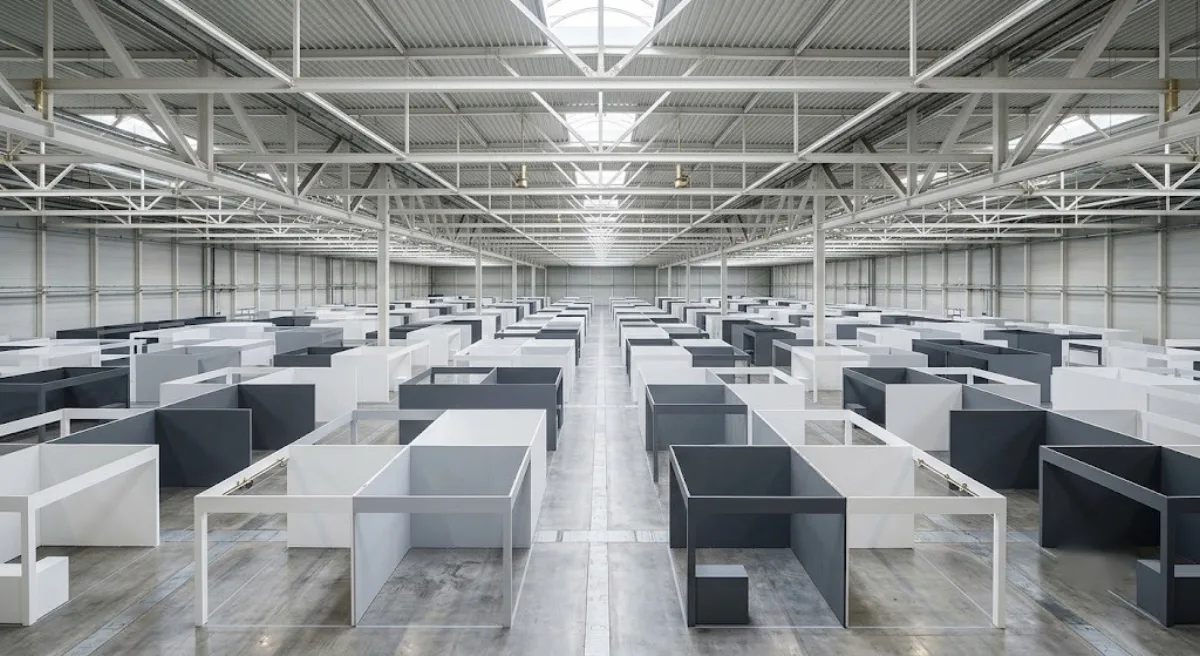
From 8 to 11 September 2026, the 17th International Logistics Exhibition (Logis-Tech Tokyo 2026) was held at Tokyo Big Sight. Occupying East Halls 1–3, 7 and 8 and West Halls 1–4, it carried 490 exhibit registrations, with further organisations participating as co-exhibitors.
For a company that imports and distributes food, cosmetics and pharmaceuticals, movements in logistics are the operating conditions of daily work. The organisers publish the exhibit descriptions, and a good deal can be read from them. This is the first of a series reading the exhibitors and their products field by field.
Seven organising bodies
The character of the exhibition shows in who organises it.
- Japan Society of Industrial Machinery Manufacturers
- Japan Industrial Vehicles Association
- Japan Pallet Association
- Japan Association of Material Handling Vehicles and Equipment
- Japan Material Handling Society
- Japan Institute of Logistics Systems
- Japan Management Association
Associations for equipment makers, for vehicles, for pallets, and then the academic and practitioner bodies for logistics. An exhibition that began as a hardware show, onto which information systems were later layered — the exhibit composition still reads that way.
What nearly every category had in common
In April 2026 the revised Act on Rationalization of Logistics came into full effect. Shippers handling 90,000 tonnes or more of freight annually, transport operators with 150 or more vehicles, and warehouse operators with 700,000 tonnes or more of storage are designated as “specified operators”, required to appoint a Chief Logistics Officer (CLO) and to prepare medium-term plans and file periodic reports. Penalties for non-compliance with orders are also provided for.
Reading through the exhibit descriptions, what stood out was that exhibits presenting compliance with this regime as their selling point appeared across categories — from measuring instruments to dispatch systems to consultancies, the pitches point in the same direction.
What has been discussed as “the 2024 problem” has moved into a phase of regulatory compliance. The composition of this year’s exhibits shows it.
The official zones do not reveal the contents
The organisers use nine official zones. The distribution of exhibitors across them is heavily skewed.
| Official zone | Exhibits |
|---|---|
| Conveying, sorting and picking | 109 |
| Logistics operations support | 96 |
| Information equipment, software and AI | 92 |
| Industrial vehicles, material handling vehicles and trucks | 46 |
| Pallets, containers and storage equipment | 45 |
| Logistics sites and facility development | 39 |
| Packaging and packing | 27 |
| 3PL, consulting and carriers | 24 |
| Publishing and associations | 12 |
The largest zone, “conveying, sorting and picking”, holds 109 entries. Automated storage, AMRs, sorters, conveyors and balancers all sit inside it, so as a category it does not function. There is no reading of it that yields “look at this zone and you will understand”.
So we re-read it by function
We read each exhibitor’s published description and reclassified by what the product actually does, into nine groups.
| Group | Count | Contents |
|---|---|---|
| A. Warehouse automation and robotics | 80 | Automated storage, AMRs, autonomous forklifts, sorters, palletising robots |
| B. Industrial and material handling vehicles | 45 | Forklifts, batteries, carts and hand lifts, special-purpose vehicles |
| C. Software and IT | 81 | WMS, TMS and dispatch, SCM and trade platforms, AI and OCR |
| D. Identification, sensing and measurement | 48 | RFID and barcodes, sensors and vision, cameras and AI video |
| E. Storage and logistics materials | 63 | Pallets, containers, racking, packaging and cushioning, packaging machinery |
| F. Facilities and environment | 58 | Logistics real estate, warehouse construction, facility environment, safety equipment |
| G. Services and operators | 86 | 3PL, ports, airports and municipalities, consulting, human resources |
| H. Cold chain | 10 | Refrigeration equipment, insulated containers, temperature recording |
| I. Parts and components | 19 | Upstream suppliers to equipment manufacturers |
Each group is subdivided further, into 36 sub-categories. This series works through them one sub-category at a time.
Three caveats when reading
- Exhibit count and corporate count are not the same. Some corporations exhibited at two booths, so the number of companies is lower than 490.
- The organisers’ “exhibitor category” field is self-declared at application. Entries inconsistent with reality appear, so this series does not assert companies’ nationality.
- Published content is as of August 2026. Current specifications should be confirmed on each company’s official site.
Coming next
- Packaging and cushioning materials (19) — the shift away from plastics toward paper
- Cold chain and temperature control (10) — directly relevant to pharmaceutical and food imports
- Pallets (12) — standardisation and rental pools
- Automated storage and shuttles (20)
- AMRs and AGVs (16)
- Logistics real estate (22)
This series is built from the exhibit descriptions submitted to and published by the organisers, together with publicly available information on each company’s site. We do not compare or rate the exhibitors. The purpose is to set out what was exhibited and where the technology is moving.
![Ten Cold Chain and Temperature Control Exhibits — Equipment That Cools, Containers That Hold, Devices That Record [Part 2]](/wp-content/uploads/2026/09/incape-ltt-coldchain.webp)